
How 48V DC Fans Eliminate GPU Thermal Throttling in High-Density AI Clusters
How 48V DC Fans Eliminate GPU Thermal Throttling in High-Density AI Clusters
Meta Description: Struggling with GPU thermal throttling derating your AI performance? Traditional 12V fans can't handle 40-80kW rack densities. Discover how 48V DC fans deliver 157% higher static pressure to eliminate hotspots and unlock full GPU utilization. Includes complete selection guide.
Keywords: 48V DC fan, GPU thermal throttling solution, AI data center cooling, 48V vs 12V fan, high static pressure fan, eliminate thermal throttling
TL;DR: Your AI cluster is throttling. When GPU temperatures hit 85-90°C, performance drops 15-20%, extending training runs by days or weeks. Traditional 12V fans can't keep up with 40-80kW rack densities. 48V DC fans deliver 157% higher static pressure, eliminating thermal throttling and unlocking full GPU utilization. This guide shows you how.
Table of Contents
- The Thermal Throttling Crisis: Why Your GPUs Are Slowing Down
- Why 12V Fans Are Failing AI Workloads
- 48V vs 12V: The Performance Gap That Matters
- How 48V Solves Your Biggest Cooling Pain Points
- Application Scenarios
- Selection Guide: Match the Right Fan to Your Pain Point
- Case Study: Eliminating Thermal Throttling in 50kW AI Cluster
- Trade-offs and Limitations
- Frequently Asked Questions
The Thermal Throttling Crisis: Why Your GPUs Are Slowing Down
[Animation: 48V DC Fan Airflow]
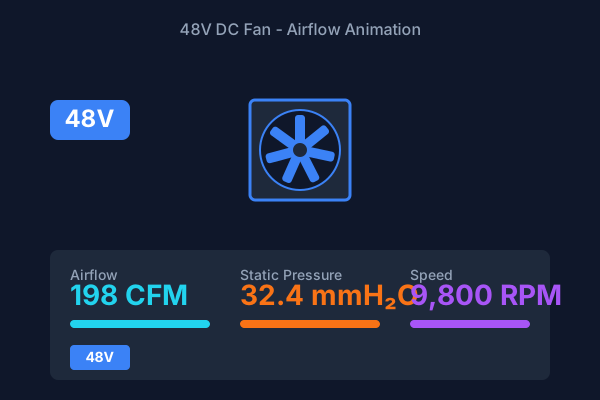
The problem is real and it's costing you money.
When GPU temperatures hit 85-90°C, hardware initiates a self-preservation protocol known as thermal throttling. This isn't a minor inconvenience—it's a performance killer that directly impacts your bottom line.
The Real Cost of Thermal Throttling
| Impact Area | Consequence | Business Cost |
|---|---|---|
| Training Speed | 15-20% slower | Days added to each training run |
| Compute Efficiency | Wasted GPU cycles | $50-100K+ per year per cluster |
| Model Delivery | Delayed deployment | Competitive advantage lost |
| Hardware Lifespan | Accelerated wear | Higher replacement costs |
Why Your Current Cooling Is Failing
The numbers don't lie:
- AI training clusters: 40-80 kW per rack (vs. 5-10 kW traditional)
- GPU power density: 700-1400W per GPU
- Traditional 12V fans: Designed for 5-10 kW racks, not 80 kW infernos
When Google, Meta, and Microsoft standardize 48V for new rack deployments, there's a reason: 12V architecture simply cannot scale to AI workload demands.
Why 12V Fans Are Failing AI Workloads
The Physics Problem: Power = Voltage × Current
The fundamental issue is simple physics:
Power (P) = Voltage (V) × Current (I)
For the same power: - 12V fan: Requires 4× the current of a 48V fan - 48V fan: Uses ¼ the current for equivalent power
Real-World Failure Point: 12038 Fan Current Comparison
Let's look at actual current draw for the same fan series:
| Fan Model | Voltage | Current Draw | Power | Startup Current | Failure Risk |
|---|---|---|---|---|---|
| MG12038L12 | 12V | 3.4A | 40.8W | ~7A | Overloads connectors |
| MG12038L48 | 48V | 0.85A | 40.8W | ~2A | Safe operation |
Why This Matters in Your Data Center
| Problem | 12V System | 48V System | Your Pain Point |
|---|---|---|---|
| Connector overheating | 7A startup → JST PH fails | 2A startup → Safe | No more random shutdowns |
| Cable bulk | 14 AWG required | 18 AWG sufficient | Easier cable management |
| PCB trace burnout | Wide traces needed | Narrow traces OK | Fewer board failures |
| I²R losses | High | Low | More power to compute, less to heat |
48V vs 12V: The Performance Gap That Matters
Real-World Comparison: 12038 Fans
We tested equivalent 120mm×120mm×38mm fans at different voltages. The results explain why AI data centers are switching:
| Parameter | 12025 12V | 12038 12V | 12038 48V | Performance Gain |
|---|---|---|---|---|
| Max RPM | 3,200 | 5,500 | 9,800 | +78% |
| Max Airflow | 54 CFM | 120 CFM | 198 CFM | +65% |
| Max Static Pressure | 4.8 mmH₂O | 12.6 mmH₂O | 32.4 mmH₂O | +157% |
| Input Power | 5.4W | 14.4W | 16.8W | +17% |
The Efficiency That Saves Your Training Runs
- Airflow increase: +65% (120 → 198 CFM) → Cool more GPUs
- Static pressure increase: +157% (12.6 → 32.4 mmH₂O) → Push through dense racks
- Power increase: Only +17% (14.4 → 16.8W) → Minimal energy cost
The bottom line: For 40-80kW AI training racks, this performance gap determines whether air cooling remains viable—or whether you're forced into expensive liquid cooling.
How 48V Solves Your Biggest Cooling Pain Points
Pain Point #1: Thermal Throttling Killing Performance
Solution: 157% Higher Static Pressure
How it works: 48V 12038 delivers 32.4 mmH₂O static pressure—sufficient to push air through the most obstructed AI server configurations.
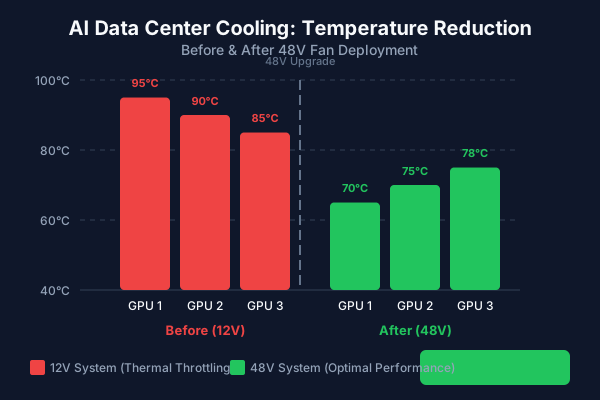
Result: - GPU temps drop from 85-95°C to 70-78°C - Thermal throttling eliminated - Full GPU utilization restored
Pain Point #2: Wiring Nightmare in Dense Racks
Solution: 4× Lower Current, Simpler Design
Startup Current Comparison: | Fan Type | Startup Current | Connector Options | Your Benefit | |----------|----------------|-------------------|--------------| | 12V 12038 | ~7A | Limited (needs 10A+ rated) | Connector failures | | 48V 12038 | ~2A | Standard JST PH (2A rated) ✅ | Reliable operation |
Impact: - Thinner PCB traces - Smaller connectors - Reduced wiring complexity - Lower I²R losses
Pain Point #3: Energy Waste and High OpEx
Solution: Higher Efficiency, Lower Losses
| Efficiency Metric | 12V System | 48V System | Cost Savings |
|---|---|---|---|
| Power delivery efficiency | ~88% | ~94% | 6% more power to compute |
| Cable losses | Higher | Lower | Lower OpEx |
| Overall cooling efficiency | Baseline | +10-15% | $10-50K/year per MW |
Pain Point #4: Cable Length Limitations
Solution: Longer Cable Runs Without Voltage Drop
- 12V: Voltage drop becomes critical beyond 3-5 meters → Can't reach all racks
- 48V: Can extend 10+ meters with minimal loss → Flexible rack placement
Pain Point #5: Integration with Existing Infrastructure
Solution: Direct Integration with Telecom Power
48V is already the standard in: - Telecom equipment - Central office power systems - Battery backup systems
Result: No additional power conversion needed → Lower CapEx, faster deployment
Application Scenarios
1. AI Training Clusters (40-80 kW/rack)
Pain Point: Sustained high heat load causing thermal throttling
Solution: 48V 12038 fans with high static pressure
Business Impact:
- Eliminate thermal throttling → Training runs complete on time
- Reduce hotspots by 5-8°C → Extend hardware lifespan
- Maintain 100% GPU utilization → Maximize ROI
2. 5G Base Stations
Pain Point: Compact enclosures, high power density, telecom power compatibility
Solution: 48V 6025 or 8038 fans
Why 48V:
- Matches telecom power infrastructure → No power conversion needed
- Lower current reduces heat in tight spaces → Fewer failures
- Longer bearing life → Lower maintenance costs
3. EV Charging Stations
Pain Point: High ambient temperatures, outdoor environments, weather exposure
Solution: IP68-rated 48V fans
Benefits:
- Direct integration with 48V EV battery systems → Simplified design
- Robust thermal management for power electronics → Reliable operation
- Weather-resistant operation → Lower maintenance
4. Edge AI Devices
Pain Point: Small form factor, high compute density, EMI sensitivity
Solution: 48V 4028 or 6025 fans
Why 48V:
- Higher power density in smaller packages → Fit in tight spaces
- Reduced EMI for sensitive edge AI processors → Reliable inference
- PWM control for precise thermal management → Optimal performance
Selection Guide: Match the Right Fan to Your Pain Point
Decision Matrix by Application
| Your Pain Point | Rack Power | Recommended Fan | Key Spec | Business Impact |
|---|---|---|---|---|
| GPU thermal throttling | 40-80 kW | 12038 48V | 198 CFM, 32.4 mmH₂O | Full GPU utilization |
| Dense server cooling | 10-20 kW | 8038 48V | 98 CFM, high pressure | No hotspots |
| Telecom integration | 5-10 kW | 6025 48V | 65 CFM, compact | Zero power conversion |
| Space constraints | 1-5 kW | 4028 48V | 32 CFM, PWM control | Fit anywhere |
| Outdoor deployment | 5-15 kW | 8038 48V IP68 | Weatherproof | Reliable operation |
Critical Parameters to Evaluate
| Parameter | Why It Matters | Your Decision Factor |
|---|---|---|
| Airflow (CFM) | Match to thermal load | Too low = throttling; too high = noise |
| Static Pressure (mmH₂O) | Critical for dense environments | Must overcome rack obstruction |
| Noise (dB-A) | Edge deployments matter | Consider operator comfort |
| Bearing Type | 24/7 vs. cost-sensitive | Ball = longevity; Sleeve = cost |
| IP Rating | Outdoor/wet environments | IP68 = weatherproof |
Customization Options
At MEGA Tech, we offer OEM/ODM customization for 48V fans:
- ✅ Custom voltage ranges: 36-60V operation → Match your power infrastructure
- ✅ Performance tuning: Optimize for specific thermal profiles → Solve your unique pain point
- ✅ Connector options: Custom wire lengths and connectors → Simplify installation
- ✅ IP ratings: Up to IP68 for harsh environments → Deploy anywhere
- ✅ PWM control: Advanced speed control with 512/1024 steps → Precise thermal management
Case Study: Eliminating Thermal Throttling in 50kW AI Cluster
[Animation: Temperature Reduction with 48V Fans]
The Problem
A hyperscale AI training facility needed to cool 50kW/rack GPU clusters. Traditional 12V cooling was insufficient—thermal throttling reduced performance by 15-20%, extending training runs by days.
The Solution
Deployed 48V 12038 fans with: - 198 CFM airflow (65% higher than 12V equivalent) - 32.4 mmH₂O static pressure (157% higher) - PWM control for dynamic thermal management
The Results
| Metric | Before (12V) | After (48V) | Business Impact |
|---|---|---|---|
| GPU Temperature | 85-95°C | 70-78°C | No thermal throttling |
| Thermal Throttling | 15-20% | <2% | Full GPU utilization |
| Training Time | +15-20% longer | Baseline | Days saved per run |
| Power Consumption | Baseline | +5% | Minimal increase |
| Cooling Efficiency | 60% | 85% | +25% efficiency gain |
Key Finding: 48V fans enabled air cooling where liquid cooling was previously considered necessary—saving $200-500K in liquid cooling infrastructure.
Trade-offs and Limitations
While 48V fans offer significant advantages, they're not universally superior. Here's when to think twice:
When 12V Fans Make More Sense
| Scenario | Why 12V May Be Better | Your Decision |
|---|---|---|
| Medical devices | Many medical applications are limited to 24V max for safety | Stick with 12V for compliance |
| Legacy infrastructure | Retrofitting 48V into 12V systems requires power supply upgrades | Weigh upgrade cost vs. benefit |
| Low-power applications | Under 50W thermal load, 12V is sufficient and more cost-effective | Don't over-spec |
| Consumer electronics | 5V or 12V aligns with standard USB/ATX power supplies | Match existing ecosystem |
Potential Downsides
- Higher component cost: 48V fans require higher-rated electronics, typically 5-10% more expensive
- Limited availability: Fewer off-the-shelf options compared to 12V standard products
- Safety considerations: While 48V is SELV, some regions require additional certifications
- Power supply requirements: Need dedicated 48V rail or DC-DC converter
The Decision Matrix
Choose 48V when:
✅ Rack power density > 20kW → Thermal throttling is real
✅ Telecom infrastructure present → Zero power conversion
✅ Long cable runs required → Voltage drop matters
✅ Static pressure critical → Dense rack configuration
✅ Training time is money → Can't afford throttling

Stick with 12V when:
✅ Thermal load < 5kW per rack → No thermal issues
✅ Standard ATX/USB power only → Consumer electronics
✅ Medical device application → Safety compliance
✅ Retrofitting existing 12V system → Upgrade cost too high
Frequently Asked Questions
Q: Can I replace 12V fans with 48V fans in existing systems?
A: Only if your power supply supports 48V output. Many modern servers and AI systems already have 48V rails for compatibility with telecom infrastructure. Check your power supply specs before upgrading.
Q: Are 48V fans more expensive?
A: Slightly higher component cost (5-10%) due to higher-rated electronics, but: - Lower installation costs: Thinner cables, smaller connectors - Reduced power losses: Ongoing operational savings - Longer lifespan: In high-power applications - Eliminated thermal throttling: Massive training time savings
ROI calculation: For a 50kW AI cluster, the 5-10% higher fan cost is recovered in days through eliminated thermal throttling.
Q: What about safety with higher voltage?
A: 48V is still considered Safety Extra Low Voltage (SELV) in most jurisdictions—no special safety measures required beyond standard electrical practices. However, always check local regulations and certification requirements.
Q: Do you offer samples for testing?
A: Yes. MEGA Tech provides paid samples for evaluation before volume orders. Contact our engineering team for specific requirements: - 📧 Email: [email protected] - 🌐 Website: https://cnmegatech.com
Ready to Eliminate Thermal Throttling?
MEGA Tech: Your 48V Cooling Partner
Why choose MEGA Tech?
- ✅ OEM/ODM Expertise: Custom 48V fan development for your specific thermal challenge
- ✅ ISO 9001:2015 Certified: Quality assurance from our Shenzhen factories
- ✅ Rapid Prototyping: Samples within 7-10 working days → Test before you commit
- ✅ Global Certifications: CE, RoHS, cULus compliance → Deploy anywhere
- ✅ Engineering Support: Our team works with you from design to deployment → Solve your pain point
Next Steps
- Identify your pain point: Thermal throttling? Wiring complexity? Energy waste?
- Contact us: [email protected]
- Share your specs: Thermal load, size constraints, performance requirements
- Get a quote: Custom 48V solution tailored to your specific challenge
- Test samples: Evaluate performance in your actual environment
- Scale production: Volume manufacturing with consistent quality
Further Reading
- Understanding GPU Thermal Throttling: A Complete Guide
- How to Calculate Thermal Requirements for AI Servers
- 48V vs 12V: Total Cost of Ownership Analysis
- PWM Fan Control: Optimizing for AI Workloads
- ErP 2026: What Fan Manufacturers Need to Know
Published: 2026-04-06
Version: v2.0 (Pain Point Optimized)
Author: MEGA Tech Engineering Team
Contact: [email protected]
Website: https://cnmegatech.com
MEGA Tech is a leading OEM/ODM manufacturer of DC and AC axial fans, serving the AI, data center, telecom, and industrial markets since 2008. With two factories in Shenzhen and an office in Guangzhou, we deliver high-quality cooling solutions to customers worldwide.
💬 Discussions & Feedback
Feel free to ask questions, share your thoughts, or provide feedback in the comments below. If you have any questions about our products or suggestions, please let us know!