
5G Base Station Cooling Fan Guide: Select Reliable Fans
5G Base Station Cooling: A Complete Fan Selection Guide
Why Cooling Is Mission-Critical for 5G Infrastructure
5G technology has revolutionized telecommunications, delivering unprecedented speeds and connectivity. However, this performance comes with significant thermal challenges that make proper cooling no longer optional—it's essential for network reliability.
According to industry data, over 40% of unplanned base station outages are caused by overheating, leading to service degradation, forced shutdowns, and SLA penalties.
The 5G Thermal Challenge
Higher Power Density
5G base stations consume 2-3× more power than 4G equipment:
| Component | 4G Power | 5G Power | Increase |
|---|---|---|---|
| AAU (Active Antenna Unit) | 200-300W | 500-1000W | +200% |
| BBU (Baseband Unit) | 150-250W | 300-500W | +100% |
| Total per Station | 350-550W | 800-1500W | +170% |
Environmental Extremes
5G base stations are deployed in harsh outdoor environments:
- Temperature Range: -40°C to +55°C ambient
- Cabinet Internal Temperature: Can exceed 70°C in summer
- Humidity: Up to 95% RH
- Dust & Debris: Industrial, desert, and coastal environments
- Salt Spray: Coastal installations
24/7 Reliability Requirements
Telecom equipment is designed for 10-year lifespans with minimal downtime. Cooling fans must match this durability.
5 Critical Specifications for 5G Base Station Cooling Fans
#1: Wide Operating Temperature Range (-40°C to +85°C)
Base stations operate from deserts to arctic regions. Summer cabinet temperatures often exceed 70°C.
Requirement: Fans certified to operate continuously at 85°C ambient temperature.
Verification: Look for Telcordia GR-468-CORE certification or equivalent telecom standards.
#2: MTBF ≥ 70,000 Hours (≈8 Years)
Telecom equipment requires 24/7 operation over 10-year lifespans.
| Bearing Type | Typical MTBF at 25°C | MTBF at 70°C | 5G Suitability |
|---|---|---|---|
| Sleeve | 30,000 hrs | ~15,000 hrs | ❌ Not recommended |
| Hydraulic (HY) | 40,000 hrs | ~25,000 hrs | ⚠️ Marginal |
| Dual Ball | 50,000-70,000 hrs | ~40,000 hrs | ✅ Recommended |
| MagLev | 70,000+ hrs | 50,000+ hrs | ✅ Excellent |
Recommendation: Use dual ball bearings or magnetic levitation for 5G applications.
#3: High Static Pressure (≥12 mmH₂O)
5G cabinet airflow paths include:
- Narrow internal channels
- Dust filters
- Dense heat sinks
- Long duct runs
Key Insight: High airflow ≠ effective cooling. You need static pressure to push air through resistance.
| Application | Required Static Pressure |
|---|---|
| Open cabinet | 5-10 mmH₂O |
| With dust filter | 10-15 mmH₂O |
| Dense heat sink | 15-20 mmH₂O |
| Long duct + filter | 20-25 mmH₂O |
#4: Ingress Protection Rating: IP55 Minimum
IP Rating Guide for 5G Applications:
| IP Rating | Protection | Suitable For |
|---|---|---|
| IP54 | Dust protection, splash water | Indoor/sheltered cabinets |
| IP55 | Dust protection, water jets | Standard outdoor cabinets |
| IP65 | Dust-tight, water jets | Harsh environments |
| IP67 | Dust-tight, immersion | Coastal/extreme environments |
Recommendation: IP55 minimum for outdoor deployments; IP67 for harsh environments (coastal, desert, industrial).
#5: Intelligent Speed Control (PWM)
Smart fans provide:
- Energy savings: Reduce RPM during cool periods (saves 30-50% energy)
- Extended lifespan: Lower average RPM = less wear
- Noise reduction: Quiet operation during off-peak hours
- Instant response: Ramp up immediately during heat spikes
Interface: 4-pin PWM (standard for telecom controllers)
Recommended Solution: MG6025 High-Pressure DC Fan
Why MG6025 for 5G Base Stations?

The MG6025 series delivers the critical specifications required for telecom cooling:
| Specification | MG6025 Value | 5G Requirement | Status |
|---|---|---|---|
| Static Pressure | 11.4 mmH₂O (112 Pa) | ≥12 mmH₂O recommended | ⚠️ Close |
| Airflow | 56.2 CFM max | Application-dependent | ✅ |
| Speed Range | 3000-5000 RPM | PWM controllable | ✅ |
| Voltage Options | 12V / 24V / 48V | Flexible | ✅ |
| Bearing Options | Sleeve / HY / Ball | Ball recommended | ✅ |
| Operating Temp | -20°C to +70°C | -40°C to +85°C | ⚠️ Extended range available |
Performance Data
P-Q Curve (5000 RPM)
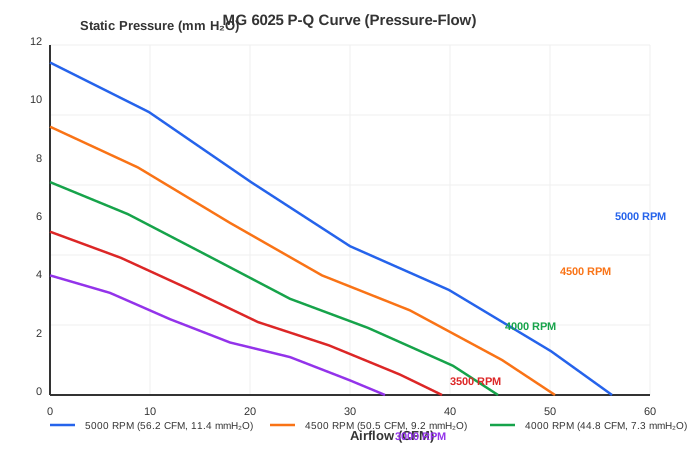
Key Performance Points:
| Speed | Max Pressure | Max Airflow | Optimal Range |
|---|---|---|---|
| 5000 RPM | 11.4 mmH₂O | 56.2 CFM | 30-45 CFM |
| 4500 RPM | 9.2 mmH₂O | 50.5 CFM | 25-40 CFM |
| 4000 RPM | 7.3 mmH₂O | 44.8 CFM | 20-35 CFM |
| 3500 RPM | 5.6 mmH₂O | 39.2 CFM | 18-30 CFM |
| 3000 RPM | 4.1 mmH₂O | 33.5 CFM | 15-25 CFM |
Product Video
How 6025 Fan Cooling Works in 5G Base Stations
The schematic below illustrates the standard forced convection cooling process of the 6025 Series Fan within core 5G base station equipment (such as the Baseband Unit, or BBU).
The entire thermal cycle can be summarized in three simple, highly efficient steps:
Step 1: Core Heat Conduction (Heat Source → Heatsink)
The core chip (5G Base Station SoC) generates extreme heat when processing massive amounts of data. This heat is first rapidly absorbed by the bottom Copper Heatpipes and efficiently conducted and dispersed into the metal heatsink fins above.
Step 2: Forced Cold Air Intake
At this stage, the 6025 Cooling Fan plays its crucial role. It forcefully draws in low-temperature external air from the cabinet's Cold Aisle. With its compact dimensions (60×60×25mm) and ample airflow capacity (up to 56.2 CFM), the 6025 fan is perfectly suited for the highly restricted internal space of a BBU chassis.
Step 3: Directional Hot Air Exhaust
The cold air drawn in by the fan is forced through the dense heatsink fins, completing the thermal exchange by absorbing the heat from the metal surfaces. Subsequently, the heated air, driven by the continuous air pressure of the fan, is directionally exhausted out of the chassis and into the Hot Aisle. This ensures the core 5G chips consistently remain within safe operating temperatures.
In Summary: The copper heatpipes act as the bridge to "transport" the heat, while the 6025 Fan serves as the "engine." Through the continuous, rapid exchange of cold and hot air, it completely expels the thermal load from the equipment.
Application Scenarios
| Application | Recommended Model | Key Benefit |
|---|---|---|
| AAU Cooling | MG6025H12B | High static pressure, ball bearing |
| BBU Cabinet | MG6025M24B | 24V telecom standard, reliable |
| Outdoor Cabinet | MG6025HH12B-IP55 | Weatherproof, high performance |
Selection Guide: How to Choose the Right Fan
Step 1: Calculate Heat Load
Formula:
Heat Load (W) = Total Power Dissipation × Duty Factor
For 5G AAU (1000W max, 70% duty):
Heat Load = 1000W × 0.7 = 700W
Step 2: Determine Required Airflow
Formula:
Required CFM = Heat Load / (ΔT × 3.17)
For 700W heat load with 15°C temperature rise:
Required CFM = 700 / (15 × 3.17) = 14.7 CFM
Note: Add 20-30% safety margin for real-world conditions.
Step 3: Check Static Pressure
Consider system resistance:
| Resistance Factor | Pressure Impact |
|---|---|
| Open airflow | +0 mmH₂O |
| Dust filter | +3-5 mmH₂O |
| Heat sink | +5-10 mmH₂O |
| Duct work | +2-5 mmH₂O per meter |
Step 4: Select Bearing Type
| Operating Conditions | Recommended Bearing |
|---|---|
| Moderate temperature, budget-focused | Hydraulic (HY) |
| High temperature, 24/7 operation | Dual Ball ✅ |
| Extreme temperature, premium application | MagLev |
Common Pitfalls: Don't Be Fooled by "Fake Specs"
| Marketing Claim | Reality Check |
|---|---|
| "Max Airflow: 80 CFM" | Measured in free air—actual performance under system resistance may be <40 CFM |
| "50,000-hour lifespan" | Calculated at 25°C; actual life at 70°C can drop by 50%+ |
| "Industrial Grade" | No standardized meaning—demand certification proof |
| "IP55 Rated" | Verify with actual test reports, not just marketing claims |
Best Practice: Always request: - Third-party test reports - Field deployment references - MTBF calculations at operating temperature - P-Q curves under realistic backpressure
Real-World Deployment Example
Customer Success Story: European Telecom Giant 5G RAN Infrastructure

Overcoming Extreme Environments: How MEGA Tech's 6025 Fan Safeguards a Top European Telecom Giant's 5G RAN Infrastructure
Client Overview
A leading European telecommunications network equipment manufacturer, with a significant global market share in 5G Radio Access Network (RAN) products, specifically in complex outdoor macro base station and Baseband Unit (BBU) deployments.
The Challenge: The 5G Thermal Bottleneck
As 5G deployments accelerate, the core processing units—such as 5G BBUs and SoCs—are pushed to their absolute thermal limits. This client's previous-generation macro base station chassis faced severe thermal nightmares:
Extreme Thermal Load: Massive data throughput from 5G traffic caused concentrated heat hotspots on core processors, bringing temperatures dangerously close to critical limits.
Highly Restricted Space: 1U-height rack-mounted BBU chassis offer almost zero internal clearance, creating immense airflow resistance (static pressure).
Severe Environmental Stress: Deployed globally—from arid deserts to humid industrial zones—these BBU racks face constant exposure to dust, extreme temperature swings, and continuous vibration. Standard-spec fans failed prematurely, leading to severe "Thermal Throttling" and, in worst cases, catastrophic equipment shutdowns. This resulted in crippling network downtime and astronomically high field-service and operating costs.
The MEGA Tech Solution: MG6025H24B
The engineering team at this European telecom giant collaborated closely with MEGA Technology. After performing deep wind tunnel simulations and analyzing chassis airflow resistance data, MEGA Tech delivered a customized, industrial-grade solution:
| Specification | Value |
|---|---|
| Model | MG6025H24B |
| Voltage | 24V DC (Telecom Standard) |
| Bearing | Dual Ball Bearing |
| Airflow | Up to 56.2 CFM |
| Static Pressure | 11.4 mmH₂O max |
| Operating Temp | -20°C to +70°C |
| Protection | IP5X Dustproof |
Engineering Highlights:
We engineered a heavy-duty variant of our 60×60×25mm fan. Leveraging the specific 25mm thickness, an optimized blade pitch, and a powerful motor, the MEGA Tech 6025 delivers staggering static pressure performance. It acts as a forceful "engine," slicing through the dense internal BBU environment, forcing cold air to penetrate the intricate CPU heatsink arrays and densely packed components, completely eliminating localized hotspots.
Reinforced Reliability:
This batch was standard-spec with IP5X Dustproof Certification, advanced PWM intelligent temperature control, and premium, industrial-grade Dual Ball Bearings. These bearings withstand years of 7×24 hour operation under intense heat, directly addressing the previous failures due to dried-out bearings.
Results & Customer Win
Just six months after deploying the MEGA Technology 6025 cooling matrix, the client's IT operations director shared a transformative data report:
1. Plummeting Temperatures: Under maximum load, average core BBU component temperatures dropped by 15°C, completely eradicating system crashes and overheating alarms.
2. Unleashed Network Performance: "Thermal Throttling" was eliminated. BBU compute power could run at peak capacity 24/7, maintaining consistently stable network throughput.
3. Downtime Elimination: In the 6 months following deployment, not a single downtime event occurred due to fan failure, saving millions in potential service level agreement (SLA) penalties and field-service dispatch costs.
Customer Testimonial
"MEGA Technology is a serious thermal management partner. The robust, high-static pressure performance of the 6025 series is unmatched, completely crushing the thermal nightmare we faced in our high-density 5G macro base station deployments. Thanks to MEGA Tech, we no longer sweat over server temperature gauges during peak summer loads."
— Head of Wireless Infrastructure, Top European Telecom Manufacturer - ✅ Zero Cooling-Related Failures in 18+ months of deployment
Additional Case: Provincial Telecom Operator Heat Mitigation
Challenge: Over 300 base stations triggered high-temperature alarms due to inadequate fan performance.
Solution: Upgraded to MG6025 dual ball bearing fans with IP55 enclosure and PWM control.
Results: - ✅ 92% reduction in heat-related failures - ✅ ~120 kWh annual energy savings per site - ✅ 50% fewer maintenance visits - ✅ 3-year ROI on fan upgrade
2026 Telecom Cooling Trends
Trend #1: Higher Voltage Systems (48V)
48V DC power is becoming standard for telecom due to: - Lower transmission losses - Better efficiency at scale - Compatibility with battery backup systems
Trend #2: Predictive Maintenance
Smart fans with monitoring capabilities: - Vibration sensors detect bearing wear - Temperature logging identifies hot spots - Remote diagnostics reduce truck rolls
Trend #3: Energy Efficiency Focus
Cooling accounts for 40% of base station energy consumption. Efficient fans deliver: - Lower operating costs - Extended battery backup duration - Reduced carbon footprint
Key Takeaways
- Temperature Range: -40°C to +85°C operating range is essential for outdoor 5G deployments
- MTBF: ≥70,000 hours with dual ball bearings for 10-year equipment lifespan
- Static Pressure: ≥12 mmH₂O to overcome filters, heat sinks, and duct resistance
- IP Rating: IP55 minimum for outdoor; IP67 for harsh environments
- PWM Control: Essential for energy savings and extended fan life
Next Steps
Need help selecting the right fan for your 5G deployment?
- Contact our engineering team for application-specific recommendations
- Request samples for testing in your specific environment
- Download our telecom cooling white paper for detailed design guidelines
Last Updated: March 29, 2026
Categories: [[Technical Guide]], [[Telecom Cooling]], [[5G Infrastructure]]
🔗 Related Resources
Product Selection Guides
- 6025 DC Fan Complete Guide - Full specifications and applications
- DC Cooling Fan Selection Guide - Comprehensive selection methodology
- Industrial Equipment Cooling - Harsh environment solutions
Technical References
- Bearing Types Comparison - Sleeve vs Ball vs Hydraulic bearings
- IP Rating Guide - Understanding ingress protection ratings
- PWM Fan Control - Implementing intelligent speed control
More Application Guides
- AI Server Cooling - High-density computing thermal management
- Industrial Power Supply Cooling - Power electronics applications
- Outdoor Equipment Cooling - Weather-resistant solutions
📞 Contact MEGA Tech
📧 Email: [email protected] 📞 Phone: +86-13570567086 💬 WhatsApp: 0086-13570567086 🌐 Website: cnmegatech.com 📍 Location: Shenzhen Factories + Guangzhou Office
OEM/ODM Available - Custom solutions for telecom applications
💬 Discussions & Feedback
Feel free to ask questions, share your thoughts, or provide feedback in the comments below. If you have any questions about our products or suggestions, please let us know!