
AI Server Cooling: Top 5 Solutions for HPC Workloads
AI Server Cooling Guide 2026: Top 5 Cooling Solutions
High-Density Computing Demands Advanced Thermal Management
The AI revolution is here. With GPU power consumption exceeding 400W per card and dense server configurations generating massive heat, proper cooling is no longer optional—it's critical for performance and reliability.
This guide covers the top 5 cooling solutions for AI servers in 2026, with real performance data and selection criteria.
The Challenge: AI Server Heat Density
Modern AI servers face unprecedented thermal challenges:
| Component | Power (2024) | Power (2026) | Heat Increase |
|---|---|---|---|
| High-end GPU | 300-450W | 400-600W | +33% |
| CPU (Server) | 200-350W | 300-500W | +43% |
| Per GPU (AI Server) | 2-4 fans | 4-8 fans | +100% |
Industry Data: According to recent market research, the AI server cooling market is projected to grow at 18.5% CAGR from 2025 to 2030, driven by:
- Generative AI workload demands
- Edge AI deployment growth
- Data center density increases
- 5G infrastructure expansion
Top 5 Cooling Solutions for AI Servers
#1: 12025 High-Performance DC Fan (MG12025 Series)
Best for: Main server cooling, GPU rack exhaust, chassis cooling
Key Specifications
| Parameter | Value |
|---|---|
| Dimensions | 120×120×25mm |
| Voltage Options | 12V / 13.2V |
| Airflow Range | 48.1-90 CFM |
| Static Pressure | 14.9-48 Pa |
| Speed Range | 1500-2700 RPM |
| Noise Level | 17-36 dB-A |
| Lifespan | 20,000-70,000 hrs |
| Bearing Types | Sleeve, Ball, Hydraulic |
Complete Technical Specifications
| Specification | Value | Application Notes |
|---|---|---|
| Size | 120×120×25mm | Standard server form factor |
| Rated Voltage | 12V / 13.2V | Multiple power options |
| Operating Voltage | 7.5-13.5V (12V), 8.5-14.5V (13.2V) | Wide operating range |
| Rated Current | 0.08-0.39A | Energy efficient |
| Rated Power | 0.96-4.68W | Low power consumption |
| Air Flow | 48.1-90 CFM | Maximum heat dissipation |
| Max Air Pressure | 14.9-48 Pa | Overcome airflow resistance |
| Noise Level | 17-36 dB-A | Ultra-quiet operation |
| Bearing Types | Sleeve, Ball, Hydraulic | 20K/50K/70K hrs lifespan |
| Frame Material | UL94V-0 Flame Retardant | Safety certified |
| MOQ | 1 pc | Flexible ordering |
| Lead Time | 7-15 days | Fast delivery |
- High Airflow: Up to 90 CFM for maximum heat dissipation
- Wide Voltage Range: 7.5-14.5V operating range for flexible integration
- Multiple Bearing Options: Choose based on lifespan requirements
- UL94V-0 Certified: Flame retardant construction for safety
P-Q Curve Performance
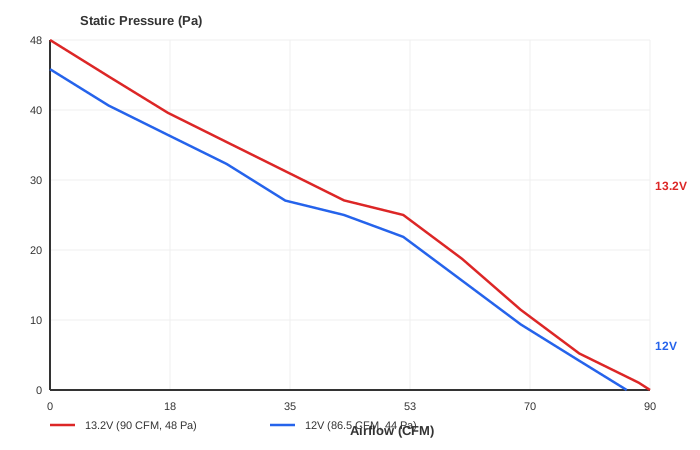
13.2V Configuration: - Maximum Airflow: 90 CFM - Optimal operating range: 35-53 CFM
#2: 6025 Compact High-Pressure Fan (MG6025 Series)
Best for: GPU direct cooling, tight space applications, 2U/1U servers
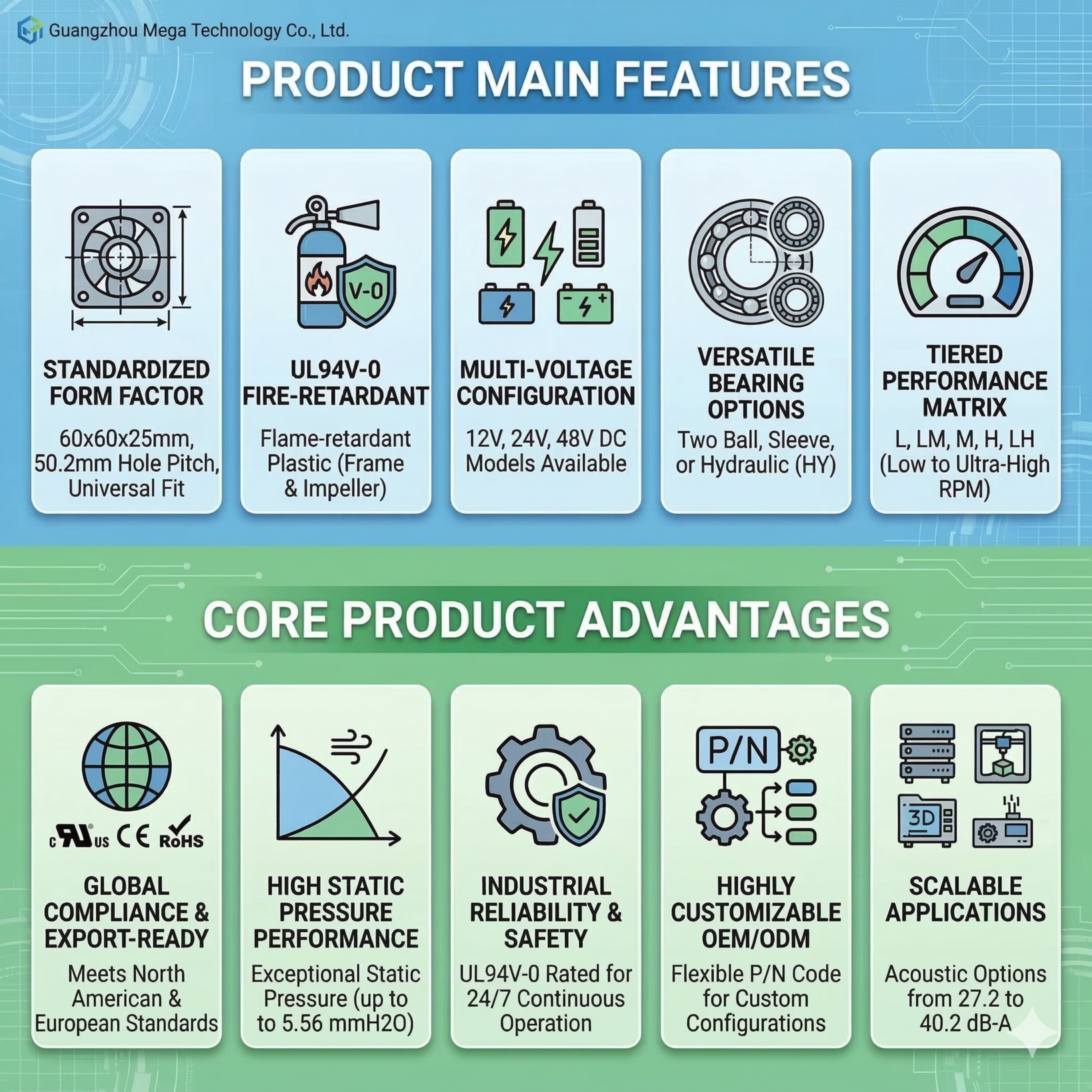
Key Specifications
| Parameter | Value |
|---|---|
| Dimensions | 60×60×25mm |
| Voltage Options | 12V / 24V / 48V |
| Airflow Range | 15.7-26.9 CFM |
| Static Pressure | 5.56 mmH₂O (54.5 Pa) |
| Speed Range | 3000-5000 RPM |
| Noise Level | 27.2-40.2 dB-A |
| Weight | 60g |
Why Choose 6025 for AI Servers?
- Multi-Voltage Flexibility: 12V/24V/48V options for different server architectures
- High Static Pressure: 5.56 mmH₂O for pushing air through dense heat sinks
- Compact Form Factor: Fits in space-constrained 2U/1U configurations
- Three Bearing Technologies: Sleeve (30K hrs), Hydraulic (40K hrs), Ball (50K hrs)
Application Scenarios
- 2U Rackmount Servers: Direct GPU cooling
- NAS Devices: High-density storage cooling
- Telecom Equipment: Base station cooling
- Industrial Control Cabinets: Embedded system cooling
#3: 4010 Ultra-Compact DC Fan
Best for: Edge AI devices, compact embedded systems, mini PCs
Key Specifications
| Parameter | Value |
|---|---|
| Dimensions | 40×40×10mm |
| Airflow | Up to 8.5 CFM |
| Static Pressure | 3.2 mmH₂O |
| Speed | 2000-4000 RPM |
| Noise | 18-28 dB-A |
#4: 3010 Micro Cooling Solution
Best for: IoT gateways, small form factor AI accelerators
Key Specifications
| Parameter | Value |
|---|---|
| Dimensions | 30×30×10mm |
| Airflow | Up to 5.2 CFM |
| Static Pressure | 2.1 mmH₂O |
| Speed | 1800-3500 RPM |
#5: 2006 Micro Blower
Best for: Ultra-thin devices, specialized cooling applications
Key Specifications
| Parameter | Value |
|---|---|
| Dimensions | 20×20×6mm |
| Type | Centrifugal blower |
| Airflow | Up to 2.8 CFM |
| Static Pressure | 8.5 mmH₂O |
Selection Guide: How to Choose
Step 1: Calculate Required Airflow
Formula:
Required CFM = (Heat Load in Watts) / (ΔT × 3.17)
Where: - Heat Load = Total power dissipation (W) - ΔT = Allowable temperature rise (°C) - 3.17 = Conversion factor
Example: For a 500W GPU with 15°C temperature rise:
Required CFM = 500 / (15 × 3.17) = 10.5 CFM per GPU
Step 2: Consider Static Pressure Requirements
| Application | Required Static Pressure |
|---|---|
| Open chassis | 5-10 Pa |
| Dense heat sink | 20-50 Pa |
| Filter systems | 30-60 Pa |
| Long duct runs | 40-80 Pa |
Step 3: Bearing Type Selection
| Bearing Type | Lifespan | Noise | Cost | Best For |
|---|---|---|---|---|
| Sleeve | 20,000-30,000 hrs | Very Quiet | $ | Budget systems, intermittent use |
| Hydraulic (HY) | 30,000-50,000 hrs | Ultra-Quiet | $$ | Office environments, NAS |
| Dual Ball | 50,000-70,000 hrs | Quiet | $$$ | 24/7 operation, servers |
Real-World Deployment: AI Server Example
Scenario: 8-GPU AI Training Server
Configuration: - 8× GPU (500W each) = 4000W - 2× CPU (300W each) = 600W - Total Heat Load: 4600W
Cooling Solution: - Primary exhaust: 4× 12025 fans (90 CFM each) = 360 CFM total - GPU direct cooling: 16× 6025 fans (26.9 CFM each) - Intake: 2× 12025 fans with filters
Result: - Maintains GPU temperature < 75°C under full load - System PUE: 1.15 (excellent efficiency) - Noise level: 52 dB-A at 1 meter
2026 Market Trends
Trend #1: Higher Voltage Options
48V systems are becoming standard for data center deployments due to: - Lower current requirements - Reduced cable losses - Better efficiency at scale
Trend #2: Smart Fan Control
- PWM control for precise speed adjustment
- Temperature-based automatic adjustment
- Remote monitoring capabilities
Trend #3: Energy Efficiency Focus
- EC (Electronically Commutated) motors
- Variable speed drives
- Optimized blade designs for maximum CFM/Watt
Trend #4: Noise Optimization
- Aerodynamic blade designs
- Vibration dampening mounts
- Multi-blade configurations for lower RPM operation
Key Takeaways
- 12025 Series is ideal for main server cooling with up to 90 CFM airflow
- 6025 Series excels in GPU direct cooling with high static pressure (5.56 mmH₂O)
- Multi-voltage options (12V/24V/48V) provide deployment flexibility
- Bearing selection impacts lifespan: Ball (50K+ hrs) > Hydraulic (40K hrs) > Sleeve (30K hrs)
- Proper sizing is critical—calculate heat load and required CFM before selection
Next Steps
Ready to optimize your AI server cooling?
- Download our complete selection guide: Fan Selection Guide
- Compare bearing types: Bearing Types Comparison
- Contact our engineering team for custom cooling solutions
Last Updated: March 21, 2026
Categories: [[Technical Guide]], [[AI Server]], [[Cooling Solutions]]
🔗 Related Resources & Guides
Comprehensive Selection Guides
- DC Cooling Fan Selection Guide - Complete guide to selecting the right DC cooling fan for your application
- Power Electronics Cooling Solutions - Specialized cooling strategies for power supplies and power electronics
- Industrial Equipment Cooling Solutions - Harsh environment cooling solutions for industrial equipment
Product Database & Tools
🔍 Search All Products - Browse our complete database of 654+ fan models - Filter by size, voltage, application - Real-time search and comparison - Detailed specifications and performance data
📊 Product Comparison Tool - Compare multiple models side-by-side
More Product Guides
By Size: - 20-30mm Fans - Ultra-compact cooling for sensors and devices - 40mm Fans - Standard industrial size for power supplies - 60mm Fans - Medium capacity for compact power units - 80mm+ Fans - High-capacity cooling for large equipment
By Application: - AI Server Cooling - Thermal management for AI and HPC systems - Micro Blower Guide - Compact space-constrained cooling - Ultra-Thin Cooling - Sensor cooling solutions
Technical References: - Bearing Types Comparison - Detailed guide to sleeve, ball, and hydraulic bearings - Voltage Selection Guide - 5V/12V/24V/48V options explained - Fan Mounting Guide - Installation best practices
Quick Help
Need assistance? Contact our engineering team: - Technical Questions: [email protected] - Sales Inquiries: [email protected] - Support: [email protected]
Explore More: - All Technical Guides - All Products - MEGA Tech Official Site
📞 Contact MEGA Tech
📧 Email: [email protected] 📞 Phone: +86-13570567086 💬 WhatsApp: 0086-13570567086 🌐 Website: cnmegatech.com 📍 Location: Shenzhen Factories + Guangzhou Office
Need assistance? Contact our engineering team: - Technical Questions: [email protected] - Sales Inquiries: [email protected] - Custom Solutions: [email protected]
💬 Discussions & Feedback
Feel free to ask questions, share your thoughts, or provide feedback in the comments below. If you have any questions about our products or suggestions, please let us know!