
AI Era Data Center Cooling: Why Fans Still Matter in 2026
TL;DR: AI servers with 700W-1000W GPUs and 100kW+ rack densities are driving the shift to liquid cooling. However, DC fans remain essential for cooling memory modules, storage drives, and power supplies. MEGA Tech's MG8025 and MG12025 series deliver the reliability and performance needed for hybrid cooling systems.
The AI Thermal Challenge
The data center cooling landscape is experiencing a fundamental shift. In 2023, high-density racks required 15-30 kW. By 2026, AI and High-Performance Computing (HPC) clusters are pushing 100 kW per rack and beyond1.
GPU Thermal Design Power (TDP) has reached unprecedented levels: - NVIDIA H100: 700W TDP - Custom AI accelerators: Up to 1000W TDP - Dense multi-GPU configurations: 3-4 GPUs per server
This creates thermal orphans — localized hot spots that traditional airflow cannot reach. When these pockets overheat, systems throttle performance, reducing computational value2.
Cooling Technology Comparison: Air vs Liquid vs Immersion
As heat densities escalate, data centers are adopting advanced cooling methods. Here's how they compare:
| Cooling Method | Max Rack Density | PUE | Initial Investment | Maintenance Complexity |
|---|---|---|---|---|
| Advanced Air Cooling | 35 kW | 1.3-1.5 | Low | Low |
| Direct-to-Chip Liquid | 40-80 kW | 1.1-1.2 | Medium | Medium (leak risks) |
| Immersion Cooling | 100 kW+ | 1.03-1.05 | High | High (specialist fluid) |
PUE (Power Usage Effectiveness) measures total facility energy divided by IT equipment energy. Lower is better — immersion cooling achieves near-perfect efficiency at 1.03.
Key Insight: While liquid and immersion cooling handle the heavy lifting for CPUs and GPUs, air cooling remains essential for secondary components3.
Why Fans Still Matter in Liquid-Cooled Systems
The 20-30% Heat Load Not Covered by Liquid
Even the most advanced liquid cooling systems don't cover 20-30% of server heat generation. Here's where precision fans remain critical:
1. NVMe SSD Front-Intake Cooling
Gen6 and Gen7 NVMe SSDs are notorious for thermal throttling. Without regulated airflow across drive bays: - Read/write speeds can degrade by 50% within minutes - Storage reliability suffers
Solution: High-pressure fans on front bezels draw cold air through dense drive arrays.
2. Mid-Chassis "Memory and VRM Engine Room"
High-bandwidth memory (HBM3e/4) and Voltage Regulator Modules (VRMs) surrounding the CPU are often air-locked behind liquid manifolds.
Solution: Specialized fan walls force air through high-impedance, narrow gaps that liquid loops cannot access.
3. Power Supply Unit (PSU) Embedded Cooling
PSUs converting high-voltage DC for AI clusters produce significant local heat. They're electrically complex and cannot be easily liquid-cooled.
Solution: High-velocity fans with integrated cooling prevent catastrophic component melting in PSU housings.
4. Rear-Exhaust "Heat Scavenging"
Fans at the rear of server racks ensure hot air moves into exhaust plenums, preventing re-entry into cold aisles.
Fan Technology Requirements for AI Era
Modern data center fans must meet demanding specifications:
| Parameter | Requirement | Why It Matters |
|---|---|---|
| MTBF | 70,000+ hours (8 years) | 24/7 operation, minimal downtime |
| Control | PWM (0-100%) | Intelligent thermal feedback |
| Protection | IP68 | Dust and water resistance |
| Pressure | High static pressure | Overcome system impedance |
Brushless DC Motors (BLDC): The Industry Standard
| Characteristic | Brushed Motor | Brushless DC (BLDC) |
|---|---|---|
| Lifespan | 10,000-30,000 hours | 50,000-100,000 hours |
| Efficiency | 60-70% | >80% |
| EMI | High | Minimal |
| Noise | High | Low |
BLDC motors with PWM control achieve 1% speed adjustment precision, crucial for CPU cooling and industrial automation4.
AI-Driven Smart Cooling
Intelligent Thermal Management
Machine learning models, such as Long Short-Term Memory (LSTM) networks, can predict heat patterns in data centers:
- Response time reduction: 40%
- Energy consumption reduction: 25%
Real-world example: Huawei's data center systems achieve a 30% increase in cooling efficiency through cloud-based control of fan matrices4.
IoT Integration
Networked fans supporting protocols like Modbus or CAN enable: - Remote RPM monitoring - Fault alerts - Cluster optimization
Predictive Maintenance
Combinations of vibration sensors and AI algorithms can detect bearing wear 300+ hours in advance, enabling proactive replacement in mission-critical setups4.
MEGA Tech Solutions for Hybrid Cooling
MG8025 Series: 80×80×25mm DC Fan
Designed for: UPS systems, solar inverters, EV chargers
Key Specifications: - Speed Range: 2000-5000 RPM - Airflow: 22.6-56.2 CFM - Static Pressure: 1.8-11.4 mmAq - Noise: 25.8-46.3 dB-A - Rated Voltage: 12V/24V/48V DC - Power: 1.2-6.0W
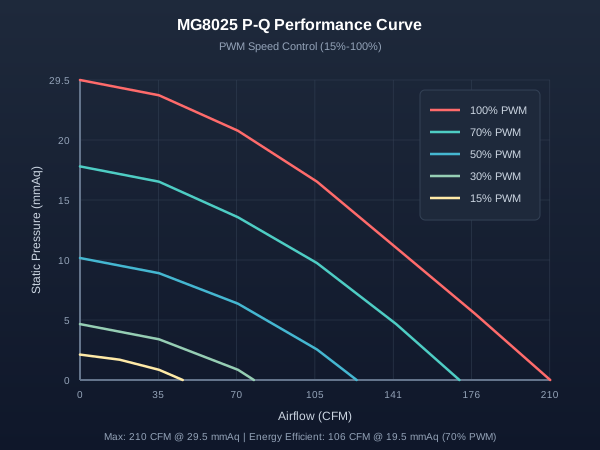
P-Q Performance Data (mmAq):
| PWM Duty | Max Pressure | Max Airflow |
|---|---|---|
| 100% | 29.5 mmAq | 210 CFM |
| 70% | 21.0 mmAq | 169 CFM |
| 50% | 12.0 mmAq | 124 CFM |
| 30% | 5.5 mmAq | 78 CFM |
Recommended Models: - MG8025L12X (2500 RPM): Low-noise UPS backup - MG8025M12X (3000 RPM): Standard UPS cooling - MG8025H12X (5000 RPM): Commercial solar arrays - MG8025HH12X (5000 RPM): High-power DC fast chargers
MG12025 Series: 120×120×25mm DC Fan
Designed for: Servers, data centers, high-performance computing
Key Specifications: - Speed Range: 1500-2700 RPM - Airflow: 48.1-90 CFM - Static Pressure: 14.9-48 Pa - Noise: 17-36 dB-A - Rated Voltage: 12V / 13.2V - Power: 0.96-4.68W
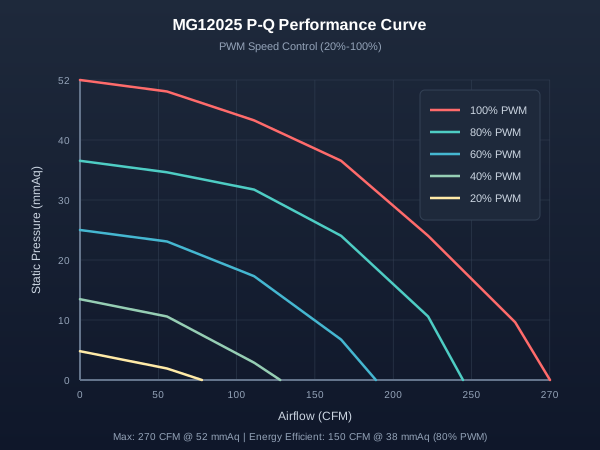
P-Q Performance Data (mmAq):
| PWM Duty | Max Pressure | Max Airflow |
|---|---|---|
| 100% | 52 mmAq | 270 CFM |
| 80% | 38 mmAq | 220 CFM |
| 60% | 26 mmAq | 170 CFM |
| 40% | 14 mmAq | 115 CFM |
| 20% | 5 mmAq | 70 CFM |
Performance Highlights: - Ultra-quiet operation: 17 dB-A (quieter than a whisper) - UL94V-0 flame-retardant materials - Multiple bearing options: Sleeve, Ball, Hydraulic - Lifespan: 20,000-70,000 hours (based on bearing type)
Recommended Applications: - Data Center Servers: MG12025 with ball bearing (50,000+ hour lifespan) - Edge Computing: MG12025 with hydraulic bearing (quiet operation) - Industrial Control: MG12025 high-pressure variant
Design Recommendations for AI-Era Cooling
1. Match Fan to System Resistance
Use P-Q curves to ensure your operating point falls in the stable region. The stall region (approximately 35-53 CFM for 12025) represents where the fan transitions from optimal operation.
Design for operation points either below or above the stall region for best performance.
2. Select Bearing Type Based on Duty Cycle
| Application | Recommended Bearing | Expected Lifespan |
|---|---|---|
| 24/7 Data Center | Ball Bearing | 50,000-70,000 hours (5.7-8.0 years) |
| Edge/Office Equipment | Hydraulic Bearing | 40,000-50,000 hours (4.6-5.7 years) |
| Budget/Short Lifecycle | Sleeve Bearing | 30,000-40,000 hours (3.4-4.6 years) |
3. Include Safety Margin
Always include 20% safety margin in pressure calculations to account for: - Filter loading over time - Component aging - Dust accumulation - Unexpected airflow restrictions
4. Consider Hybrid Cooling Architecture
Even liquid-cooled servers benefit from hybrid air-liquid designs: - Liquid cold plates handle CPU/GPU (main heat sources) - Precision DC fans cool memory, storage, VRMs, and PSUs - Prevents thermal orphans in air-locked zones
Future Trends: Beyond Traditional Fans
Ionic Cooling Technology
Emerging technologies like ionic cooling create airflow by charging ions, eliminating mechanical parts: - No moving parts = fewer mechanical failures - Automated dust sensing and cleaning - 2-3 CFM of targeted airflow can clear thermal orphans2
However, ionic cooling complements rather than replaces traditional fans in most applications.
Sustainable Manufacturing
Future DC fans will incorporate: - Lead-free soldering - Recycled PC materials - 30% reduction in carbon footprint - Compliance with EU RoHS 3.0 and ESG goals4
Conclusion
The transition from fan-centric cooling to hybrid, direct-source approaches mirrors earlier infrastructure shifts driven by AI. Just as AI forced a rethink of networking, storage, and compute architectures, it is now reshaping thermal design.
Cooling is no longer a background concern. It's becoming a first-class architectural decision.
For data center operators planning 2026 and beyond, the key questions are:
- Where do performance bottlenecks originate — facility-level airflow or device-level hot spots?
- Is throttling already occurring under sustained AI load?
- Do edge or compact systems lack serviceability or supervision?
- Can targeted airflow extend system life without redesigning the entire rack?
Direct-source cooling technologies like MEGA Tech's precision DC fans don't replace existing infrastructure — they delay costly redesigns, protect performance, and extend hardware ROI.
Ready to Optimize Your Thermal Strategy?
Contact MEGA Tech
- Official Website: cnmegatech.com
- Get a Quote: cnmegatech.com/contact/
- WhatsApp: 0086-13570567086
- Product Blog: mega.556871.xyz
Quick Response
- Quotation: Within 24 hours
- Technical support: Real-time during business hours
- Sample delivery: 5-7 business days
Related Resources
Product Guides: - 8025 DC Fan Guide — Multi-speed cooling for power electronics - 12025 DC Fan Guide — High-performance industrial cooling - DC Cooling Fan Selection Guide — Complete selection methodology
Technical References: - Bearing Types Comparison — Sleeve vs Ball vs Hydraulic - Power Electronics Cooling Solutions — Industrial applications
Search Products: - Product Database Query — Browse 654+ fan models
References
Last Updated: April 2026
MEGA Technology Co., Ltd. — Professional Cooling Fan Manufacturer Since 2008
ISO 9001:2015 | CE | RoHS | UL94V-0 Compliant
-
ACDC EC Fan. "Next-Gen Server Cooling Solutions: Managing Heat in 2026." December 2025. ↩
-
Data Center POST. "Why 2026 Will Be a Turning Point for Server Cooling." February 2026. ↩↩
-
Ventiva. "Direct-Source Cooling for AI Workloads." 2026. ↩
-
FansCo. "DC Fan Technology: Principles and Innovations." May 2025. ↩↩↩↩
💬 Discussions & Feedback
Feel free to ask questions, share your thoughts, or provide feedback in the comments below. If you have any questions about our products or suggestions, please let us know!