
Integrated Thermal Management System: Optimal Fan Selection Guide for EV Applications
TL;DR: Integrated Thermal Management Systems (ITMS) unify battery, motor, and cabin cooling into a single optimized architecture. This guide explains how to select the right fans for each thermal circuit, with specific recommendations for EC motor technology that delivers 70% energy savings and 50,000+ hour reliability.
The Problem: Why Fan Selection Matters in ITMS
Electric vehicles face a critical thermal challenge: three distinct heat sources (battery, motor, cabin) with different temperature requirements, sharing limited space and energy budget. Traditional approach? Separate cooling systems. Result?
- ❌ 15-40% range loss from HVAC alone
- ❌ 200+ individual components
- ❌ Complex control logic
- ❌ Higher failure points
ITMS changes this equation: One unified thermal architecture, intelligent heat routing, and optimized fan selection as the backbone.
Market context: The EV battery cooling market will grow from $2.31B (2024) to $5.64B (2029) at 19.54% CAGR. Liquid cooling dominates 65% of new installations, but fans remain essential for:
- Auxiliary air cooling in hybrid systems
- Radiator/heat exchanger airflow
- Electronics cooling (inverters, converters)
- Cabin HVAC distribution
What is Integrated Thermal Management System (ITMS)?
Definition
ITMS (Integrated Thermal Management System) is a unified cooling architecture that manages heat flow between:
- Battery pack - Optimal range: 20-40°C
- Electric motor - Operating range: 60-100°C
- Power electronics - Inverter, converter, charger
- Cabin HVAC - Passenger comfort
Core Principle: Heat Recovery
Instead of wasting heat, ITMS routes it where needed:
- Motor waste heat → Battery preheating in cold weather
- Battery heat → Cabin heating via heat pump
- Ambient heat → Heat pump efficiency boost
Result: 10-20% range improvement in cold weather.
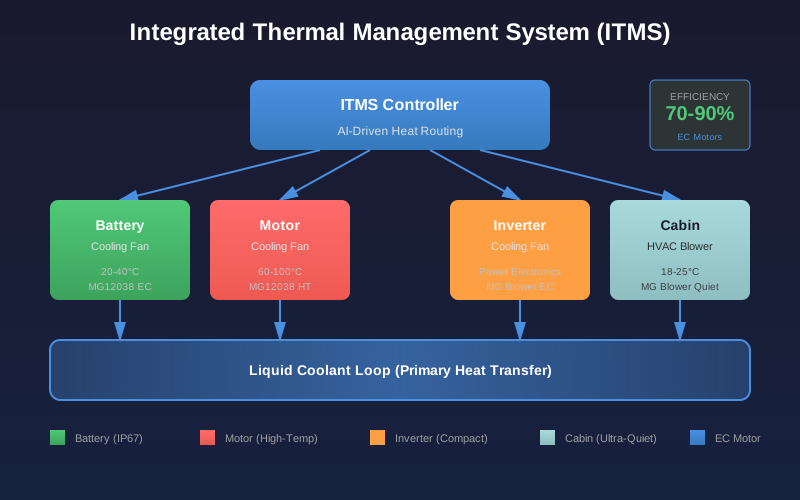
ITMS Architecture Diagram
┌─────────────────────────────────────────────────────┐
│                    ITMS Controller                   │
│              (AI-Driven Heat Routing)               │
└──────────────┬──────────────────────────────────────┘
               │
    ┌──────────┼──────────┬──────────┬──────────┐
    │          │          │          │          │
    ▼          ▼          ▼          ▼          ▼
┌───────┐ ┌───────┐ ┌───────┐ ┌───────┐ ┌───────┐
│Battery│ │ Motor │ │Inverter│ │ Heat  │ │ Cabin │
│Cooling│ │Cooling│ │Cooling │ │Exchanger│ │ HVAC │
│ Fan   │ │ Fan   │ │  Fan   │ │  Fan   │ │ Blower│
└───────┘ └───────┘ └───────┘ └───────┘ └───────┘
    │          │          │          │          │
    └──────────┴──────────┴──────────┴──────────┘
                         │
                  Liquid Coolant Loop
                   (Primary Heat Transfer)
The Three Thermal Circuits: Fan Requirements
Each circuit has unique thermal characteristics and fan requirements.
1. Battery Thermal Circuit
Thermal Load Profile: - Heat generation: 50-200W/kWh during fast charging - Temperature range: 20-40°C (narrow band) - Critical issue: Temperature uniformity (ΔT < 5°C)
Fan Requirements:
| Parameter | Requirement | Why It Matters |
|---|---|---|
| Airflow | 100-300 CFM | Dissipate charging heat |
| Static Pressure | 0.5-1.5 inH₂O | Overcome battery pack resistance |
| Noise | <35 dB(A) | Passenger compartment proximity |
| IP Rating | IP67 minimum | Battery pack sealing |
| Control | PWM (1-10 kHz) | Precise temperature control |
| Reliability | MTBF >50k hours | 10+ year vehicle life |
Recommended Fan Types: - ✅ EC axial fans (MG12025, MG12038) - High efficiency, IP67 option - ✅ Centrifugal blowers - For compact battery enclosures - ❌ Standard DC fans - Insufficient efficiency and lifespan
2. Motor & Power Electronics Circuit
Thermal Load Profile: - Heat generation: 1-5 kW continuous, 10+ kW peak - Temperature range: 60-100°C - Cooling method: Direct oil cooling + liquid jacket
Fan Requirements:
| Parameter | Requirement | Why It Matters |
|---|---|---|
| Airflow | 200-500 CFM | High heat dissipation |
| Static Pressure | 1.0-2.5 inH₂O | Radiator airflow resistance |
| Temperature | Up to 85°C ambient | Under-hood environment |
| Vibration | 10G rating | Motor vibration coupling |
| Control | Smart PWM + temp sensor | Load-adaptive cooling |
Recommended Fan Types: - ✅ High-temp EC fans (MG12038 HT series) - 85°C rating, high reliability - ✅ Dual-ball-bearing fans - Vibration resistance - ❌ Sleeve-bearing fans - Short lifespan in vibration
3. Cabin HVAC Circuit
Thermal Load Profile: - Load: 1-5 kW (heating/cooling) - Temperature: 18-25°C (passenger comfort) - Challenge: 15-40% range impact in extreme weather
Fan Requirements:
| Parameter | Requirement | Why It Matters |
|---|---|---|
| Airflow | 150-400 CFM | Cabin volume circulation |
| Static Pressure | 0.3-1.0 inH₂O | Ductwork resistance |
| Noise | <30 dB(A) at 1m | Passenger comfort critical |
| Control | Multi-speed + auto | Climate control integration |
| Size | Compact profile | Under-dash space constraints |
Recommended Fan Types: - ✅ Ultra-quiet EC centrifugal blowers - <28 dB(A) at full speed - ✅ Compact axial fans - For HVAC distribution - ❌ AC fans - Inefficient, noisy, limited control
Fan Type Selection Decision Tree
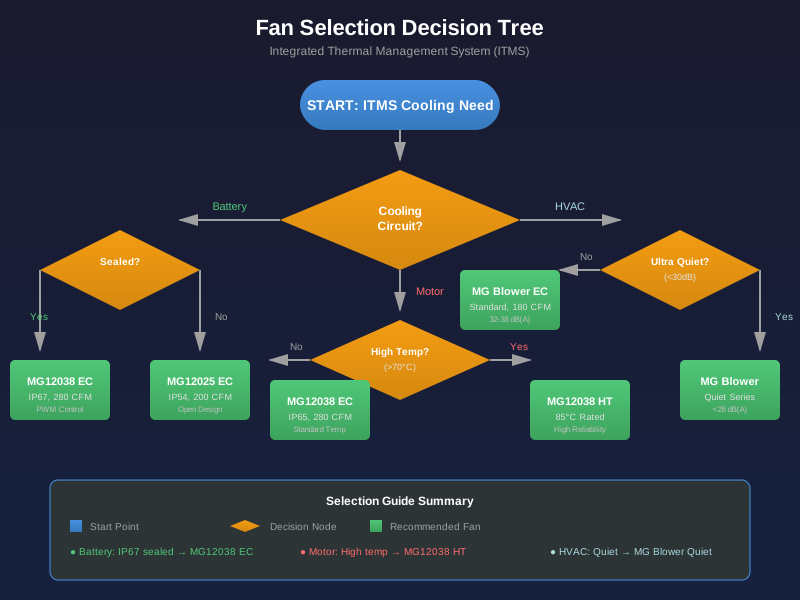
Quick Selection Guide:
| Application | Primary Fan Type | Key Features | MEGA Tech Series |
|---|---|---|---|
| Battery cooling | EC Axial | IP67, PWM control | MG12025 EC, MG12038 EC |
| Motor radiator | EC Axial HT | 85°C rated, high airflow | MG12038 HT |
| Inverter cooling | EC Centrifugal | High static pressure, compact | MG Blower EC |
| Cabin HVAC | EC Centrifugal Quiet | <28 dB(A), auto control | MG Blower Quiet |
Why EC Motors Are the Optimal Choice
EC vs DC vs AC: Efficiency Comparison
| Technology | Efficiency | Speed Control | Lifespan | Noise | Cost |
|---|---|---|---|---|---|
| AC | 30-50% | Poor | Medium | High | Low |
| DC | 50-70% | Good | Medium | Medium | Medium |
| EC | 70-90% | Excellent | High | Low | Higher |
EC (Electronically Commutated) motors combine: - ✅ AC motor durability (brushless design) - ✅ DC motor controllability (electronic speed control) - ✅ 70-90% efficiency (vs 50-70% for DC)
Real-World Impact: Energy Savings Calculation
Scenario: 10 kW motor cooling system, 8 hours/day operation
| Fan Type | Power Draw | Daily Energy | Annual Cost* |
|---|---|---|---|
| AC fan (40% eff) | 250W | 2.0 kWh | $73 |
| DC fan (60% eff) | 167W | 1.33 kWh | $49 |
| EC fan (85% eff) | 118W | 0.94 kWh | $34 |
*Assumes $0.10/kWh, 365 days
Result: EC fans save $39/year per fan vs AC, $15/year vs DC.
For a vehicle with 5 fans: $195/year savings with EC technology.
MEGA Tech ITMS Fan Solutions
Product Line Overview
EC Axial Fans:
| Series | Size | Airflow | Static Pressure | IP Rating | Application |
|---|---|---|---|---|---|
| MG12025 EC | 120×25mm | 150-200 CFM | 0.8-1.2 inH₂O | IP67 | Battery cooling |
| MG12038 EC | 120×38mm | 200-280 CFM | 1.2-2.0 inH₂O | IP67 | Motor radiator |
| MG12038 HT | 120×38mm | 180-250 CFM | 1.0-1.8 inH₂O | IP65 | High-temp zones |
EC Centrifugal Blowers:
| Series | Size | Airflow | Static Pressure | Noise | Application |
|---|---|---|---|---|---|
| MG Blower EC | 97mm | 120-180 CFM | 1.5-2.5 inH₂O | 32-38 dB | Inverter cooling |
| MG Blower Quiet | 97mm | 100-150 CFM | 1.0-2.0 inH₂O | <28 dB | Cabin HVAC |
Key Advantages
✅ 70% Energy Efficiency - EC motor technology reduces power consumption ✅ Wide Temperature Range - -40°C to +85°C operating range ✅ Intelligent Control - PWM and analog control options ✅ High Reliability - MTBF >50,000 hours (10+ years) ✅ IP67 Protection - Dust-tight, water-submersible options ✅ Custom Solutions - Tailored to specific ITMS requirements
Technical Specifications: MG12038 EC (Example)
Model: MG12038-12B2-EC
Dimensions: 120×120×38mm
Voltage: 12V DC
Current: 1.8A max
Power: 21.6W max
Speed: 2800 RPM (PWM controlled)
Airflow: 245 CFM max
Static Pressure: 1.65 inH₂O max
Noise: 38 dB(A) at full speed
IP Rating: IP67
Bearing: Dual ball bearing
MTBF: 60,000 hours at 40°C
Temperature Range: -40°C to +85°C
Control: PWM 1-10 kHz or 0-10V analog
Fan Selection Workflow
Step-by-Step Process
Step 1: Define Thermal Load
Heat load (W) = Power loss (W) = Efficiency loss × Input power
Example: 150 kW motor at 95% efficiency
Heat load = 0.05 × 150,000 = 7,500 W
Step 2: Calculate Required Airflow
Airflow (CFM) = Heat load (W) / (ΔT × 1.08)
Where ΔT = allowable temperature rise (°F)
Example: 7,500 W heat, ΔT = 20°F
Airflow = 7,500 / (20 × 1.08) = 347 CFM
Step 3: Determine Static Pressure - Measure system resistance (ductwork, heat exchanger) - Typical range: 0.5-2.5 inH₂O - Add 20% safety margin
Step 4: Select Fan from Performance Curve - Locate operating point (airflow × static pressure) - Verify fan can deliver at least 110% of required airflow - Check efficiency at operating point
Step 5: Verify Environmental Constraints - Temperature: Must operate at max ambient + margin - IP rating: Match to installation environment - Vibration: Check bearing type and G-rating
Step 6: Integrate Control System - PWM control for EC fans - Temperature sensor feedback - CAN/LIN bus communication for vehicle integration
Trade-offs and Limitations
Honest Assessment
EC Fan Advantages: - ✅ High efficiency (70-90%) - ✅ Precise speed control - ✅ Long lifespan (50k+ hours) - ✅ Low noise
EC Fan Trade-offs: - ❌ Higher upfront cost (2-3× AC fans) - ❌ Requires electronic control (PWM/analog) - ❌ EMI considerations (shielding may be needed)
When EC Fans Are NOT Optimal: - Extreme cost-sensitive applications (AC fans acceptable) - Simple on/off control (DC fans sufficient) - Harsh environments without proper IP rating
System-Level Considerations
ITMS Design Challenges: - Control complexity: AI-driven thermal routing requires sophisticated software - Integration cost: Higher component quality increases BOM cost - Failure modes: Single thermal failure can cascade to multiple systems - Maintenance: Unified system requires holistic diagnostics
Case Study: ITMS Fan Deployment
Scenario: Mid-Size EV (60 kWh Battery, 150 kW Motor)
Thermal Requirements:
| Circuit | Heat Load | Required Airflow | Recommended Fan |
|---|---|---|---|
| Battery cooling | 1.5 kW (fast charge) | 280 CFM | 2× MG12038 EC |
| Motor radiator | 7.5 kW | 400 CFM | 2× MG12038 HT |
| Inverter | 2.0 kW | 150 CFM | 1× MG Blower EC |
| Cabin HVAC | 3.0 kW | 300 CFM | 2× MG Blower Quiet |
Total Fan Configuration: 7 fans - 4× Axial fans (battery + motor) - 3× Centrifugal blowers (inverter + cabin)
Energy Consumption: - Traditional AC/DC fans: ~450W total - MEGA Tech EC fans: ~280W total - Savings: 170W continuous = 1,489 kWh/year (8 hrs/day)
Cost-Benefit Analysis:
| Metric | AC/DC Solution | EC Solution | Improvement |
|---|---|---|---|
| Fan cost | $150 | $380 | +$230 |
| Annual energy | $54 | $33 | -$21 |
| Lifespan | 20k hours | 50k hours | +150% |
| Noise | 45 dB(A) | 32 dB(A) | -13 dB |
| Payback period | - | 11 years | - |
Conclusion: Higher upfront cost, but significant benefits in efficiency, noise, and lifespan. Break-even at 11 years (within vehicle lifecycle).
FAQ
Q: Can I use standard DC fans in ITMS? A: Possible for non-critical circuits (e.g., cabin distribution), but not recommended for battery or motor cooling. DC fans lack the efficiency, lifespan, and control precision needed for ITMS optimization.
Q: What IP rating do I need for battery cooling fans? A: Minimum IP67. Battery packs are sealed units; fans must withstand moisture, dust, and potential electrolyte exposure.
Q: How do EC fans integrate with vehicle CAN bus? A: MEGA Tech EC fans support: - Direct PWM control (1-10 kHz) - 0-10V analog control - CAN/LIN interface (optional module) - Temperature sensor input
Q: What's the typical lifespan of ITMS fans? A: MEGA Tech EC fans: MTBF 50,000-60,000 hours (10+ years at 8 hrs/day). AC/DC fans: 15,000-25,000 hours (5-7 years).
Q: Can ITMS work without fans? A: Liquid cooling can handle primary heat transfer, but fans remain essential for: - Radiator airflow (liquid-to-air heat exchange) - Electronics cooling (inverters, converters) - Cabin HVAC distribution - Backup/emergency cooling
Q: How do I calculate fan sizing for my specific ITMS? A: Follow the 6-step workflow in this guide, or contact MEGA Tech for free thermal simulation and fan selection support.
Further Reading
- 120mm DC Fan Selection Guide - Detailed EC vs DC comparison
- EV Battery Cooling Technologies - Thermal management deep dive
- Industrial Fan Selection Methodology - General fan sizing principles
- EC Motor Technology Explained - How EC motors work
- Data Center Cooling Best Practices - High-reliability fan applications
Get Expert Support
Thermal Simulation & Fan Selection: Our engineers provide free ITMS thermal analysis and fan recommendation for your specific application.
Custom Solutions: Tailored fan designs for unique ITMS requirements - form factor, IP rating, control interface, performance curves.
Contact: [email protected]
Published: April 2026 Category: Technical Guide Tags: ITMS, Thermal Management, EV Cooling, EC Fans, Fan Selection
This article assumes familiarity with basic thermal management concepts and electric vehicle systems. For foundational information, see our DC Fan Fundamentals Guide.
💬 Discussions & Feedback
Feel free to ask questions, share your thoughts, or provide feedback in the comments below. If you have any questions about our products or suggestions, please let us know!