In-depth analysis of Delta FFB1212SHE cooling fan for AI data center applications. Detailed specifications, performance benchmarks, installation guidelines, and real-world case studies for GPU cluster cooling.
Comprehensive guide to medical equipment cooling fans for healthcare devices in 2026. Discover BLDC and EC fan technologies, top manufacturers like ebm-papst, SUNON, and Pelonis, specifications for ventilators, MRI machines, CT scanners, and patient monitors.
Discover the best-selling cooling fans of 2026 from industry leaders Delta, ebm-papst, Nidec, and SUNON. Learn about their specifications, applications, and why they dominate the data center and industrial cooling market.
DC4010 Fan Guide for Ender 3 & CR10: Solve Overheating & Improve Print Quality
Layer separation. Stringing. Overheated extruder jams. These common 3D printing problems often trace back to one overlooked component: the cooling fan.
If you own an Ender 3, CR10, or similar FDM printer, you're likely using a 40×40×10mm DC fan (commonly called DC4010). But not all DC4010 fans are equal—and choosing the wrong one can hurt your print quality.
This guide explains:
- Why 40mm fans matter for 3D printing
- Hotend cooling vs. part cooling requirements
- How to select the right DC4010 for your printer
- MEGA Tech DC4010 specifications and advantages
Why 40mm Fans Are Critical for 3D Printers
The Dual Cooling Challenge
FDM printers need two types of cooling:
1. Hotend Cooling (Always On)
Purpose: Keep the cold side of the hotend below 40°C while the nozzle reaches 200-260°C
What happens if it fails:
- Heat creep → filament softens prematurely
- Extruder jams mid-print
- Wasted filament, failed prints
MG4010 DC Blower: Ultra-Thin Cooling Solution for Medical & Beauty Devices
When your handheld device overheats, customers notice. A 30% feedback rate on overheating issues translates to 1-star reviews, warranty claims, and lost sales. The root cause? Inadequate cooling in compact spaces.
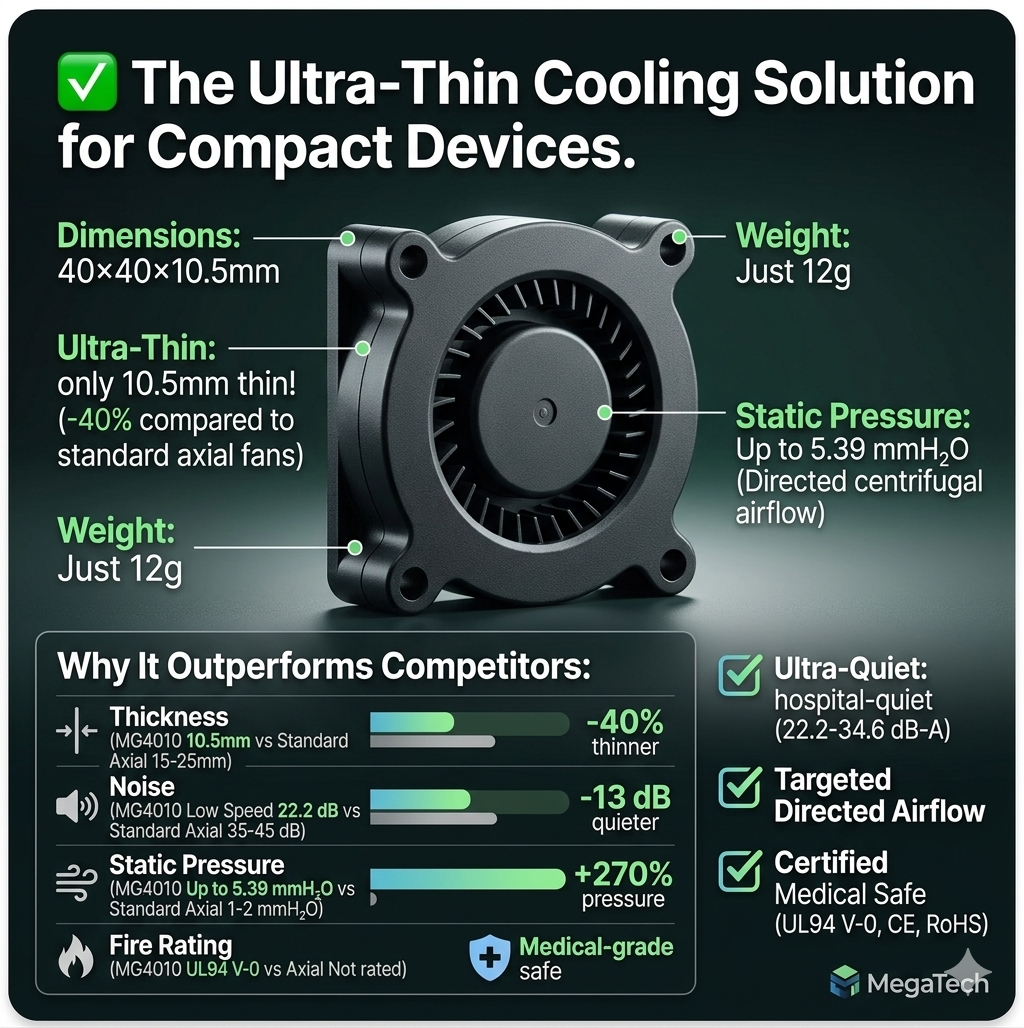
The MG4010 DC Blower from MEGA Tech solves this challenge with an ultra-thin 10.5mm profile, high static pressure (up to 5.92 mmH₂O), and whisper-quiet operation (as low as 24.6 dBA).
Why 4010 Blowers Are Essential for Compact Devices
The 40×40mm form factor has become the industry standard for small device cooling. But not all 4010 fans are created equal.
The Challenge: Axial Fans vs. Centrifugal Blowers
Traditional axial fans move large volumes of air at low pressure - fine for open spaces, but ineffective when:
Air must pass through dense heat sinks
Internal components block airflow paths
Exhaust vents are small or restricted
Centrifugal blowers like the MG4010 solve this by:
Generating focused, high-pressure airflow - Up to 5.92 mmH₂O forces air through tight spaces
90° air direction change - Ideal for compact internal layouts
Enclosed impeller design - Safer for medical devices (no exposed blades)
150×150×50mm high-performance DC/AC cooling fan for server racks and industrial applications
Introduction
When it comes to cooling high-density server cabinets and telecom enclosures, the 150mm cooling fan series (150×150×50mm) stands as the industry standard for maximum thermal performance. Unlike smaller 120mm fans that struggle to deliver adequate airflow through restricted spaces, the 150mm form factor provides the perfect balance between airflow capacity, static pressure, and installation flexibility.
At MEGA Tech, we've engineered our 150mm fan series to deliver exceptional performance across DC (12V/24V/48V) and AC (120V/230V/380V) voltage options, making them suitable for everything from 48V telecom cabinets to enterprise data centers.
Why 150mm Fans Are Essential for Cabinet Cooling
The Airflow Challenge
Server cabinets and telecom enclosures present unique cooling challenges:
High heat density: Modern servers generate 5-15kW per rack
Airflow restrictions: Filters, cable management, and component density create backpressure
Hot spots: Uneven heat distribution requires targeted cooling
Continuous operation: 24/7 reliability demands robust fan design
A typical 42U server cabinet requires minimum 200 CFM …
Discover how EC fans reduce data center cooling energy by up to 70%. This comprehensive guide covers EC vs AC fan comparison, PUE improvement strategies, and implementation best practices for 2026.
Discover the key differences between EC fans and AC fans for industrial cooling applications. Learn which technology offers better energy efficiency, performance, and ROI for your facility.
The number of cooling fans in an EV varies by thermal management design. Modern EVs typically use 3-6 fans in fan arrays for battery cooling, with EC fans becoming the 2026 standard for their 70% energy savings and precise speed control. Complete guide with fan quantity simulation calculator.