In-depth analysis of Delta FFB1212SHE cooling fan for AI data center applications. Detailed specifications, performance benchmarks, installation guidelines, and real-world case studies for GPU cluster cooling.
Comprehensive guide to medical equipment cooling fans for healthcare devices in 2026. Discover BLDC and EC fan technologies, top manufacturers like ebm-papst, SUNON, and Pelonis, specifications for ventilators, MRI machines, CT scanners, and patient monitors.
Discover the best-selling cooling fans of 2026 from industry leaders Delta, ebm-papst, Nidec, and SUNON. Learn about their specifications, applications, and why they dominate the data center and industrial cooling market.
DC4010 Fan Guide for Ender 3 & CR10: Solve Overheating & Improve Print Quality
Layer separation. Stringing. Overheated extruder jams. These common 3D printing problems often trace back to one overlooked component: the cooling fan.
If you own an Ender 3, CR10, or similar FDM printer, you're likely using a 40×40×10mm DC fan (commonly called DC4010). But not all DC4010 fans are equal—and choosing the wrong one can hurt your print quality.
This guide explains:
- Why 40mm fans matter for 3D printing
- Hotend cooling vs. part cooling requirements
- How to select the right DC4010 for your printer
- MEGA Tech DC4010 specifications and advantages
Why 40mm Fans Are Critical for 3D Printers
The Dual Cooling Challenge
FDM printers need two types of cooling:
1. Hotend Cooling (Always On)
Purpose: Keep the cold side of the hotend below 40°C while the nozzle reaches 200-260°C
What happens if it fails:
- Heat creep → filament softens prematurely
- Extruder jams mid-print
- Wasted filament, failed prints
MG4010 DC Blower: Ultra-Thin Cooling Solution for Medical & Beauty Devices
When your handheld device overheats, customers notice. A 30% feedback rate on overheating issues translates to 1-star reviews, warranty claims, and lost sales. The root cause? Inadequate cooling in compact spaces.
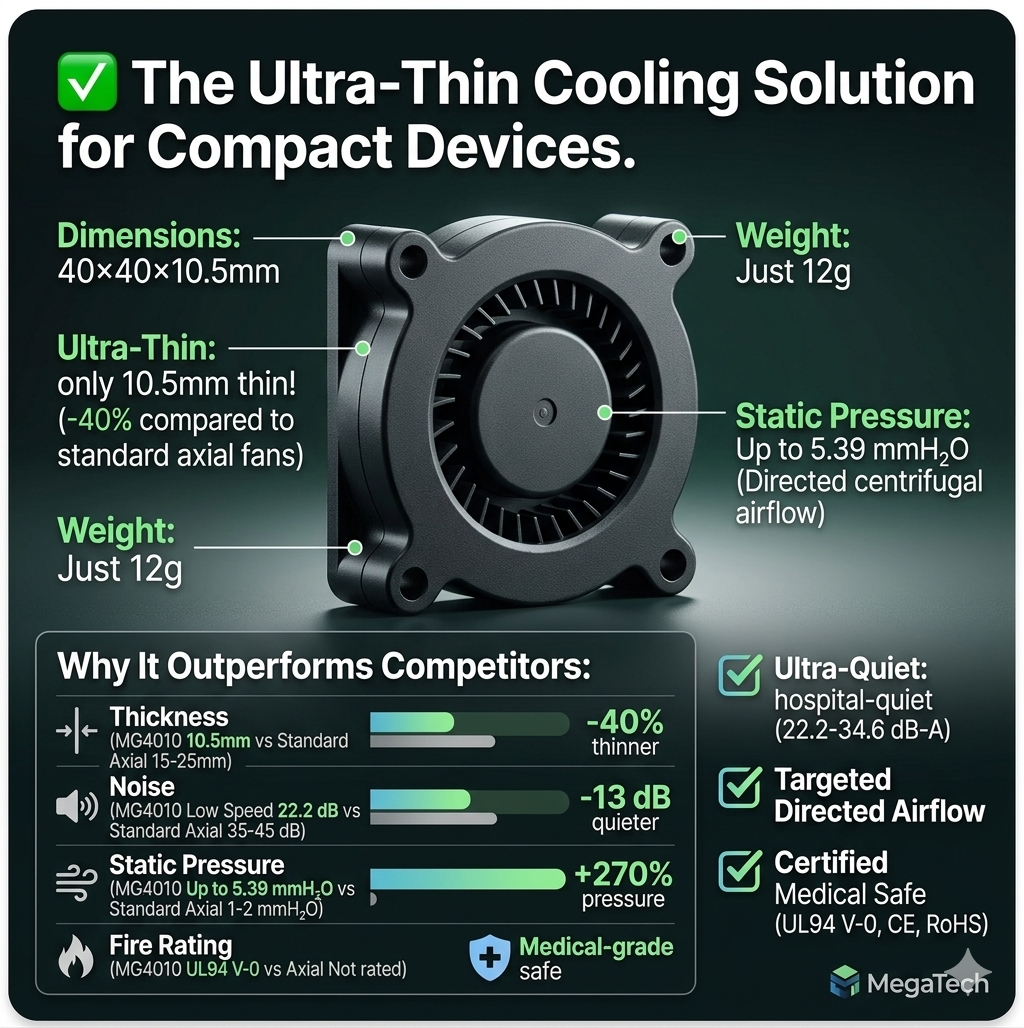
The MG4010 DC Blower from MEGA Tech solves this challenge with an ultra-thin 10.5mm profile, high static pressure (up to 5.92 mmH₂O), and whisper-quiet operation (as low as 24.6 dBA).
Why 4010 Blowers Are Essential for Compact Devices
The 40×40mm form factor has become the industry standard for small device cooling. But not all 4010 fans are created equal.
The Challenge: Axial Fans vs. Centrifugal Blowers
Traditional axial fans move large volumes of air at low pressure - fine for open spaces, but ineffective when:
Air must pass through dense heat sinks
Internal components block airflow paths
Exhaust vents are small or restricted
Centrifugal blowers like the MG4010 solve this by:
Generating focused, high-pressure airflow - Up to 5.92 mmH₂O forces air through tight spaces
90° air direction change - Ideal for compact internal layouts
Enclosed impeller design - Safer for medical devices (no exposed blades)
150×150×50mm high-performance DC/AC cooling fan for server racks and industrial applications
Introduction
When it comes to cooling high-density server cabinets and telecom enclosures, the 150mm cooling fan series (150×150×50mm) stands as the industry standard for maximum thermal performance. Unlike smaller 120mm fans that struggle to deliver adequate airflow through restricted spaces, the 150mm form factor provides the perfect balance between airflow capacity, static pressure, and installation flexibility.
At MEGA Tech, we've engineered our 150mm fan series to deliver exceptional performance across DC (12V/24V/48V) and AC (120V/230V/380V) voltage options, making them suitable for everything from 48V telecom cabinets to enterprise data centers.
Why 150mm Fans Are Essential for Cabinet Cooling
The Airflow Challenge
Server cabinets and telecom enclosures present unique cooling challenges:
High heat density: Modern servers generate 5-15kW per rack
Airflow restrictions: Filters, cable management, and component density create backpressure
Hot spots: Uneven heat distribution requires targeted cooling
Continuous operation: 24/7 reliability demands robust fan design
A typical 42U server cabinet requires minimum 200 CFM …
DC 7010 Cooling Fan: Ultra-Slim 70mm Solution for Space-Constrained Applications
In the world of electronics cooling, every millimeter counts. When you're designing a 1U server, building a compact NAS, or creating a slim 3D printer, you can't always fit a standard 25mm thick fan. That's where the DC 7010 series comes in – an ultra-slim 70x70x10mm brushless cooling fan that delivers impressive airflow in a remarkably thin profile.
Why the 70x70x10mm Form Factor Matters
The 7010 form factor (70mm diameter, 10mm thickness) is the sweet spot between the smaller 60mm fans (which often struggle with airflow) and larger 80mm fans (which may not fit in tight spaces). Here's why it's becoming increasingly popular:
Space Efficiency
10mm thickness vs. standard 25mm = 60% space savings
Perfect for 1U rack servers where height is strictly limited to 44.45mm
Ideal for compact electronics like mini-PCs, routers, and IPCs
Performance Balance
Despite its slim profile, the DC 7010 delivers:
- Up to 19.3 CFM airflow
- Up to 3.30 mmH2O static pressure
- 19.5-30.5 dBA noise levels (model dependent)
Smart Fan Technology in 2026: The Future of Intelligent Cooling with PWM and EC Motors
The cooling industry is undergoing a revolutionary transformation in 2026. Smart fan technology, powered by Pulse Width Modulation (PWM) control and Electronically Commutated (EC) motors, is redefining how we think about thermal management, energy efficiency, and intelligent automation.
The Rise of Intelligent Cooling Systems
Gone are the days when fans were simple on/off devices with limited speed settings. Today's smart fans represent the convergence of advanced motor technology, sophisticated control algorithms, and seamless IoT integration. These intelligent cooling solutions can automatically adjust their operation based on real-time environmental conditions, learn user preferences, and integrate with broader smart home and industrial ecosystems.
What Makes a Fan "Smart"?
A truly smart fan incorporates several key technologies:
PWM Control: Precision speed regulation through rapid on/off cycling
EC Motors: Brushless DC motors with integrated electronic controllers
IoT Connectivity: Remote monitoring and control via smartphones, voice assistants, or automated systems
Sensor Integration: Real-time response to temperature, humidity, and occupancy
AI & Machine Learning: Predictive adjustments based on usage patterns
PWM Control: Precision at Its Finest
Pulse Width Modulation (PWM) has become the gold standard for fan speed control in …
Discover how EC fans reduce data center cooling energy by up to 70%. This comprehensive guide covers EC vs AC fan comparison, PUE improvement strategies, and implementation best practices for 2026.
Discover the key differences between EC fans and AC fans for industrial cooling applications. Learn which technology offers better energy efficiency, performance, and ROI for your facility.
Portable Cooling Fan Market Analysis: From AI to Wearable Devices
TL;DR: The portable cooling fan market is undergoing a critical transformation from traditional handheld devices to intelligent and wearable solutions. Surging AI device cooling demands, the explosive growth of the wearable device market ($92.9 billion globally in 2025), and consumers' pursuit of personal thermal comfort are collectively driving rapid market growth. The thermal interface materials market is projected to grow from $4.56 billion in 2025 to $11.17 billion by 2033, at a CAGR of 12.0%.
Market Overview
Global Market Size
The portable cooling fan market is expanding rapidly:
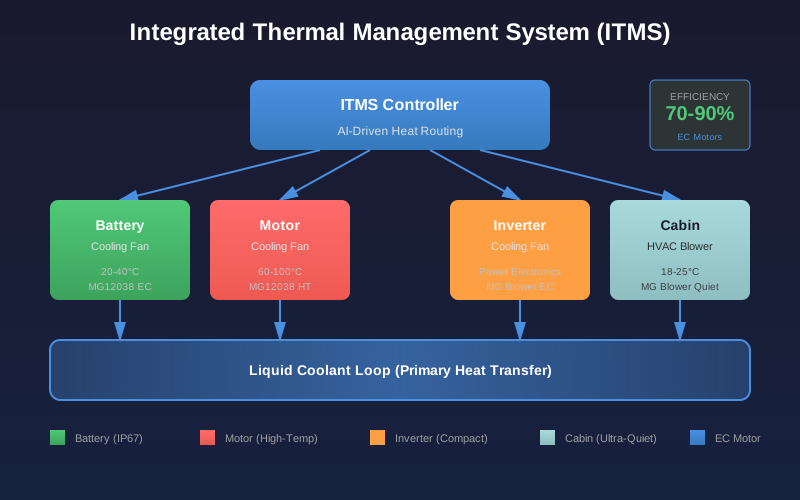
TL;DR: Integrated Thermal Management Systems (ITMS) unify battery, motor, and cabin cooling into a single optimized architecture. This guide explains how to select the right fans for each thermal circuit, with specific recommendations for EC motor technology that delivers 70% energy savings and 50,000+ hour reliability.
The Problem: Why Fan Selection Matters in ITMS
Electric vehicles face a critical thermal challenge: three distinct heat sources (battery, motor, cabin) with different temperature requirements, sharing limited space and energy budget. Traditional approach? Separate cooling systems. Result?
❌ 15-40% range loss from HVAC alone
❌ 200+ individual components
❌ Complex control logic
❌ Higher failure points
ITMS changes this equation: One unified thermal architecture, intelligent heat routing, and optimized fan selection as the backbone.
Market context: The EV battery cooling market will grow from $2.31B (2024) to $5.64B (2029) at 19.54% CAGR. Liquid cooling dominates 65% of new installations, but fans remain essential for:
Auxiliary air cooling in hybrid systems
Radiator/heat exchanger airflow
Electronics cooling (inverters, converters)
Cabin HVAC distribution
What is Integrated Thermal Management System (ITMS)?
Definition
ITMS (Integrated Thermal Management System) is a unified cooling architecture that manages heat flow between:
Complete guide to EU ErP 2026 regulation for cooling fans. Learn how EC fans achieve 30-70% energy savings compared to AC fans, compliance requirements, and MEGA Tech's ErP 2026 ready solutions.
The portable fan market is experiencing explosive growth in 2026, projected to reach $12.5+ billion. Key trends include wearable neck fans (35% market share), smart app-controlled cooling, USB-C fast charging, and ultra-quiet operation under 30dB.
The number of cooling fans in an EV varies by thermal management design. Modern EVs typically use 3-6 fans in fan arrays for battery cooling, with EC fans becoming the 2026 standard for their 70% energy savings and precise speed control. Complete guide with fan quantity simulation calculator.
The EU's ErP 2026 regulation (effective July 2026) introduces stricter efficiency requirements for fans with input power between 125W and 500kW. EC motors, with 80-90% efficiency (vs. 70-88% for AC motors), are the clear path to compliance. Learn how MEGA Tech's EC motor solutions meet these new standards while delivering superior performance and long-term cost savings.
We compared Sanyo Denki's latest 80mm DC fan releases against MEGA Tech's MG8038 and MG8032 series. MEGA Tech's MG8038VVH24X delivers 133.95 CFM at 50.02 mmH2O, outperforming Sanyo Denki's 120 CFM in airflow while maintaining competitive static pressure.
Struggling with GPU thermal throttling derating your AI performance? Traditional 12V fans can't handle 40-80kW rack densities. Discover how 48V DC fans deliver 157% higher static pressure to eliminate hotspots and unlock full GPU utilization.
Learn how IP-rated DC cooling fans prevent overheating in EV chargers. Covers thermal management for 60-350kW fast charging stations with case studies and design guidelines.
EV Charger Cooling Solutions — Thermal Management for DC Fast Charging Stations
TL;DR: High-power EV chargers (60kW–350kW) generate 3–8 kW of heat in compact enclosures. Proper thermal management with IP-rated DC cooling fans prevents power derating, extends equipment life, and ensures 24/7 reliability in outdoor environments.
EV Charger Cooling Airflow Pattern
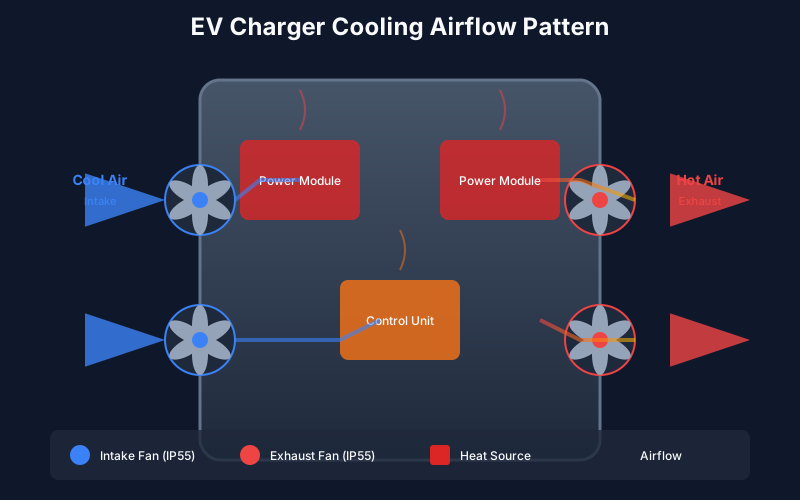
This animated diagram shows how IP55-rated MG12025 fans create efficient push-pull airflow in a 150kW DC fast charger. Blue arrows indicate cool intake air, while red arrows show hot exhaust air being removed from the enclosure.
Why Thermal Management Is Critical for EV Chargers
The Heat Challenge
DC fast chargers operate at high power densities, converting AC grid power to DC at 150–500A currents. This process generates significant heat:
Power module losses: 3–8 kW of heat in 150kW–350kW chargers
Cable and connector heating: High current density causes localized hotspots
Compact enclosures: Limited space for natural convection
Outdoor installation: Ambient temperatures from -30°C to +50°C
With AI workloads pushing GPU TDP to 1000W and rack densities beyond 100kW, liquid cooling dominates headlines. But precision DC fans remain critical for NVMe SSDs, VRMs, and hybrid cooling systems. Here's why fans still matter in the AI era.